What Is Moscato? Still, Lightly Sparkling and Pink Moscato Explained

Moscato is another name for wine made from Muscat grapes, mainly Muscat Blanc à Petits Grains. It comes in three main styles: still, lightly sparkling (frizzante, often around 5 to 6% ABV) and fully sparkling (spumante). Pink Moscato is a commercial style blended with a little red wine. Most Moscato keeps some residual sugar, so check the label.
Moscato has a loyal search following. In this morning's Google Trends pull, interest in Moscato is above its late-summer average and ahead of Riesling within the same comparison group, though still behind Chardonnay. That makes it an evergreen topic with a holiday lift, which fits: lower-alcohol and sparkling wines get more attention as people plan holiday brunches, family dinners and toasts. Moscato is also one of the most misunderstood names in wine, because the same word covers still and sparkling wines, white and pink wines, and wines from 5% to over 15% ABV. This guide sorts out the styles, explains the grape family, and shows how to read a Moscato label in five steps. It sticks to facts about how the wine is made, with no claims about flavour.
Comparison table: Moscato styles
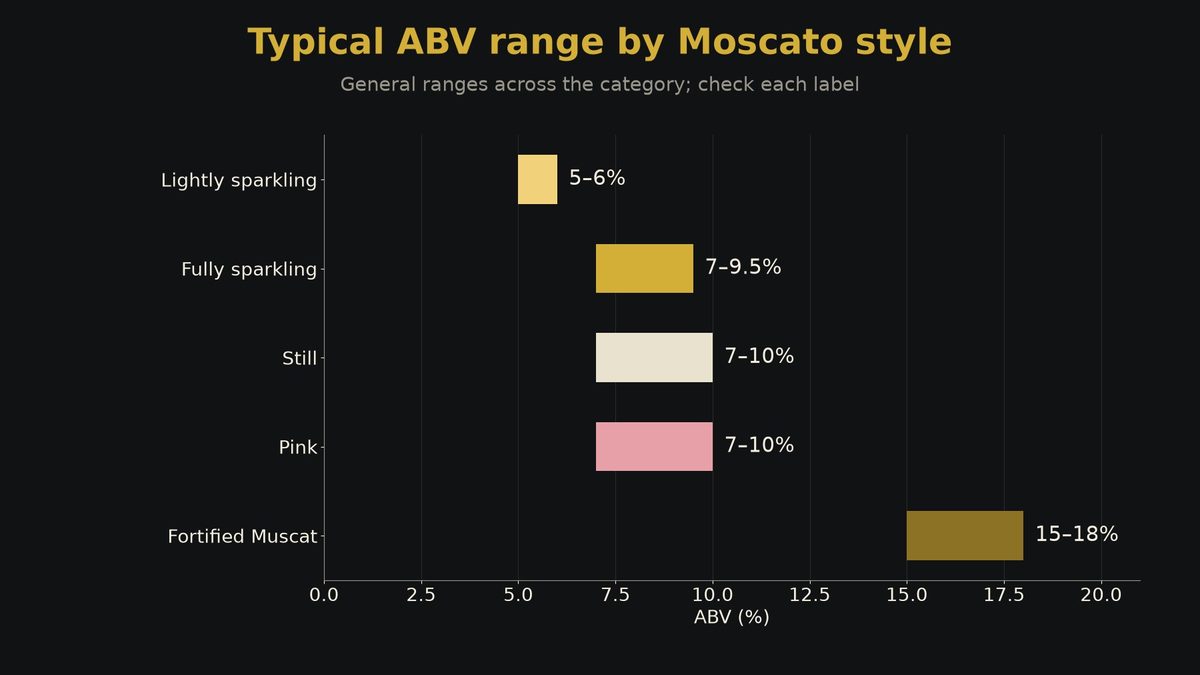
| Style | Fizz level | Typical ABV range (general; check the label) | How it's made | Usual closure |
|---|---|---|---|---|
| Lightly sparkling Moscato (frizzante) | Light bubbles, about 1 to 2.5 bar of pressure | About 5 to 6% | Fermented in a sealed tank and stopped early, keeping some bubbles and sugar | Regular cork, sometimes tied, or a screw cap |
| Fully sparkling Moscato (spumante) | Full sparkle, at least 3 bar | About 7 to 9.5% | Fermented in a sealed pressurised tank and stopped early | Mushroom cork with a wire cage |
| Still Moscato | None | About 7 to 10%, sometimes higher | Fermented without trapping bubbles, often stopped early | Screw cap or cork |
| Pink Moscato | Still or lightly sparkling | Similar to still or lightly sparkling Moscato | Moscato with a small amount of red wine added for colour | Screw cap or cork |
| Fortified Muscat | None | About 15 to 18% | Grape spirit added during fermentation, which stops it and keeps sugar | Cork or screw cap |
The ranges are general. Producers set their own ABV within the rules that apply to them, so the number on your label is the one to trust.
The Muscat grape family
"Muscat" is not one grape but a family of more than 200 related varieties, many of them among the oldest grapes still grown. The ones most likely to appear on a label are:
- Muscat Blanc à Petits Grains, the small-berried white Muscat. It is the main grape behind most quality Moscato, and it also goes by Moscato Bianco and several other names.
- Large-berried white Muscat, widely grown for wine, table grapes and raisins.
- Orange Muscat, a variety with orange-tinged berries, used for both dry and dessert wines.
- Muscat Ottonel, a paler, earlier-ripening member of the family.
All of these share a group of aromatic compounds, which is why the family is grouped together. "Moscato" and "Muscat" are simply two names for the same family. Some labels use one, some the other, and the choice usually follows the language of the label rather than the style of the wine.
Moscato vs Muscat vs sparkling wine
Because "Moscato" is so often sparkling, people sometimes confuse it with other sparkling wines. The difference is the grape and the sugar. Most dry sparkling wines are made from other grapes, such as Chardonnay, Pinot Noir or Glera, and are fermented until little sugar remains. Moscato is made from Muscat grapes and is usually stopped before all the sugar ferments. Our guide to brut vs extra dry vs demi-sec explains how sparkling wine labels describe sugar levels, and the sparkling wine category lists the full range.

Why Moscato's ABV is often low
Yeast converts grape sugar into alcohol and carbon dioxide. A dry wine is fermented until almost all the sugar is gone, which usually gives 11 to 14% ABV. Most Moscato is stopped part of the way through:
- The juice ferments in a sealed, pressurised tank, so the carbon dioxide stays in the wine as bubbles.
- When the alcohol reaches the target, often around 5 to 6% for the lightly sparkling style, the winemaker chills the tank sharply. Cold stops the yeast.
- The wine is filtered to remove the yeast, so fermentation can't restart in the bottle.
The result is a wine with less alcohol and more residual sugar than a dry wine. Fortified Muscat works the other way round: grape spirit is added during fermentation, which stops the yeast and raises the ABV at the same time. Our low-alcohol wine and spirits guide lists other wines that are naturally lighter in alcohol, and our ice wine guide covers another wine with high residual sugar.
Pink Moscato
Pink Moscato is a modern commercial style. It is Moscato with a small amount of red wine, often Merlot, blended in for colour. It is usually still or lightly sparkling and has an ABV similar to other Moscato. It is not the same as rosé made from red grapes; our guide to what rosé wine is explains how rosé is made, and the rosé wine category lists the pink wines we carry.
Steps: reading a Moscato label
- Find the style word. Look for "Moscato", "Muscat" or "Pink Moscato", and for "still", "sparkling" or "fortified".
- Check for "frizzante" or "spumante". Frizzante means lightly sparkling; spumante means fully sparkling. A bottle with neither word and a screw cap is usually still.
- Check for an appellation code. Codes such as DOC or DOCG mean the wine follows the rules of a defined wine area, including limits on grapes, yield and alcohol.
- Check the ABV. About 5 to 6% usually signals the lightly sparkling style with noticeable residual sugar. Higher numbers suggest a still or fully sparkling wine, and 15% or more means a fortified Muscat.
- Check the vintage. Most Moscato is sold for drinking young, so a recent vintage is normal. If there is no vintage, the wine is a blend of years.
Examples in our catalogue include Gallo Family Vineyards Moscato and Voerzio Martini Vignasergente Moscato. Check each label for the style and ABV. The white wine category lists all of our Moscato, and our types of white wine guide puts it alongside other white grapes.
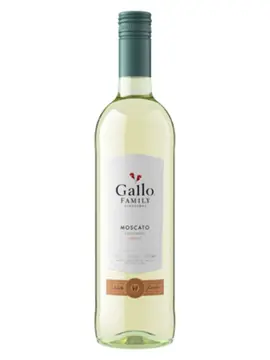
Gallo Family Vineyards Moscato
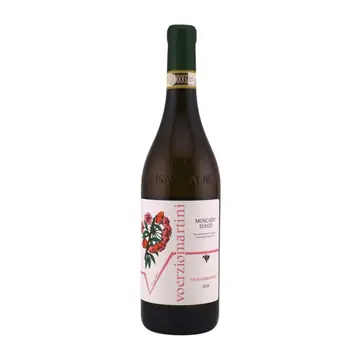
Voerzio-Martini - Vignasergente Moscato
Serving and storage
Moscato is served well chilled. Our wine serving temperature chart gives the range for sparkling and light white wines. For sparkling Moscato, chill the bottle for at least three hours in the fridge, and hold the cork firmly when opening, because the pressure can push it out. Once opened, sparkling Moscato loses its bubbles within a day or two, even with a stopper. Still Moscato keeps for a few days in the fridge with the cap on. Most Moscato is not made for long ageing, so it is usually opened within a year or two of the vintage.
Standard drinks. One standard drink contains 17.05 ml of pure ethanol. A 150 ml glass of a 5.5% lightly sparkling Moscato holds about 8.3 ml of ethanol, roughly 0.48 standard drinks. The same glass of a 9% still Moscato holds 13.5 ml, about 0.79 standard drinks. A 75 ml pour of a 16% fortified Muscat holds 12 ml, about 0.70 standard drinks. Lower alcohol per glass doesn't mean unlimited glasses, so keep count.
Frequently asked questions
Is Moscato sweet?
Most Moscato keeps some residual sugar because fermentation is stopped early. The amount varies by style and producer, so check the label and the ABV. Lower ABV usually means more residual sugar.
What is the difference between frizzante and spumante Moscato?
Frizzante is lightly sparkling, with about 1 to 2.5 bar of pressure and usually around 5 to 6% ABV. Spumante is fully sparkling, with at least 3 bar of pressure, a caged cork and usually a higher ABV.
What is Pink Moscato?
A commercial style of Moscato with a small amount of red wine, often Merlot, added for colour. It is usually still or lightly sparkling.
Is Moscato the same as Muscat?
Yes, in the sense that both names refer to wines made from the Muscat grape family. Labels use whichever name fits their language and style.
How much alcohol is in Moscato?
It depends on the style: about 5 to 6% for lightly sparkling, about 7 to 9.5% for fully sparkling, about 7 to 10% for most still Moscato and about 15 to 18% for fortified Muscat. Always check the label.
Is Moscato sparkling?
Some is and some isn't. Moscato is made still, lightly sparkling and fully sparkling. Look for "frizzante" or "spumante" on the label, or a wire cage over the cork.
Related reading
You must be of legal drinking age in your province. ID and adult signature required at delivery.