What Is Ice Wine? How Frozen-Grape Dessert Wine Is Made and Labelled

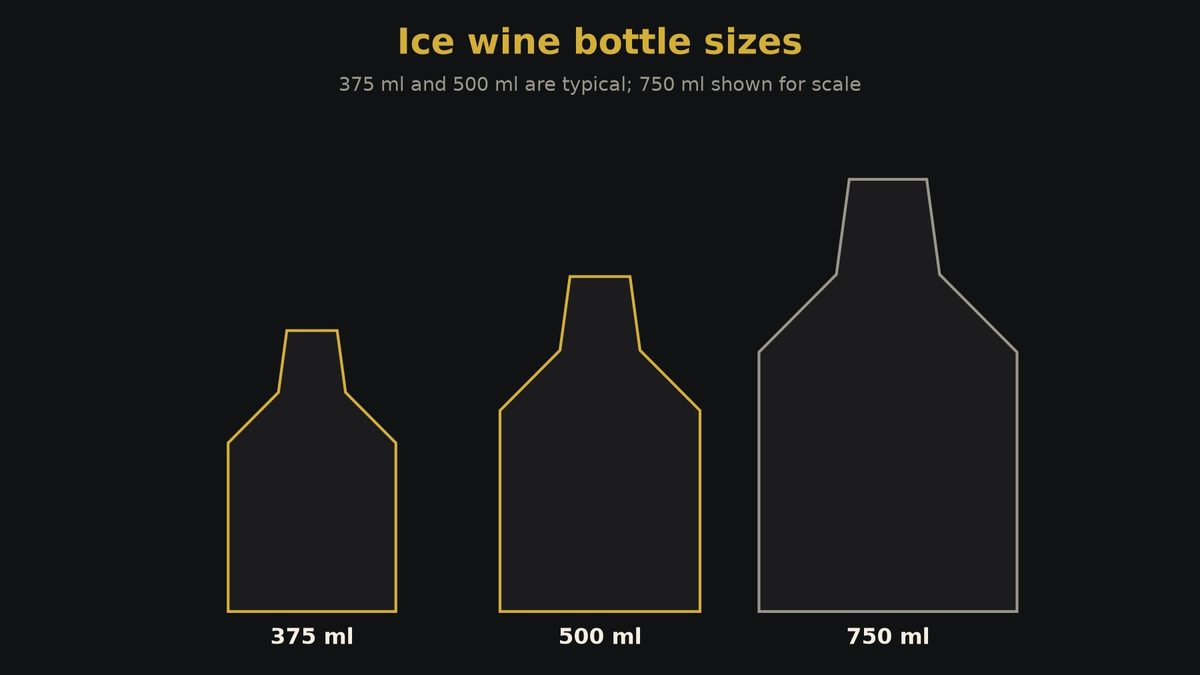
Ice wine is a dessert wine made from grapes left to freeze naturally on the vine and pressed while still frozen, so only a small amount of concentrated, sugary juice runs off. Labelling rules set a minimum harvest temperature and ban artificial freezing. It usually comes in 375 or 500 ml bottles. Check the label for the grape and vintage.
Searches for ice wine have been climbing through the autumn in Google Trends, and broader interest in dessert wine has risen alongside it. The timing is seasonal: ice wine is a common choice to finish a holiday dinner and a popular small-format gift. This guide explains how it is made, what the label words mean, how it compares with other sweet wines and how to serve and store a bottle. It is a facts-only guide and does not describe how any wine tastes.
How ice wine is made
1. Hang time. The grapes are left on the vine well past the normal harvest. Growers often net the vines to keep birds off the fruit through late autumn and into winter.
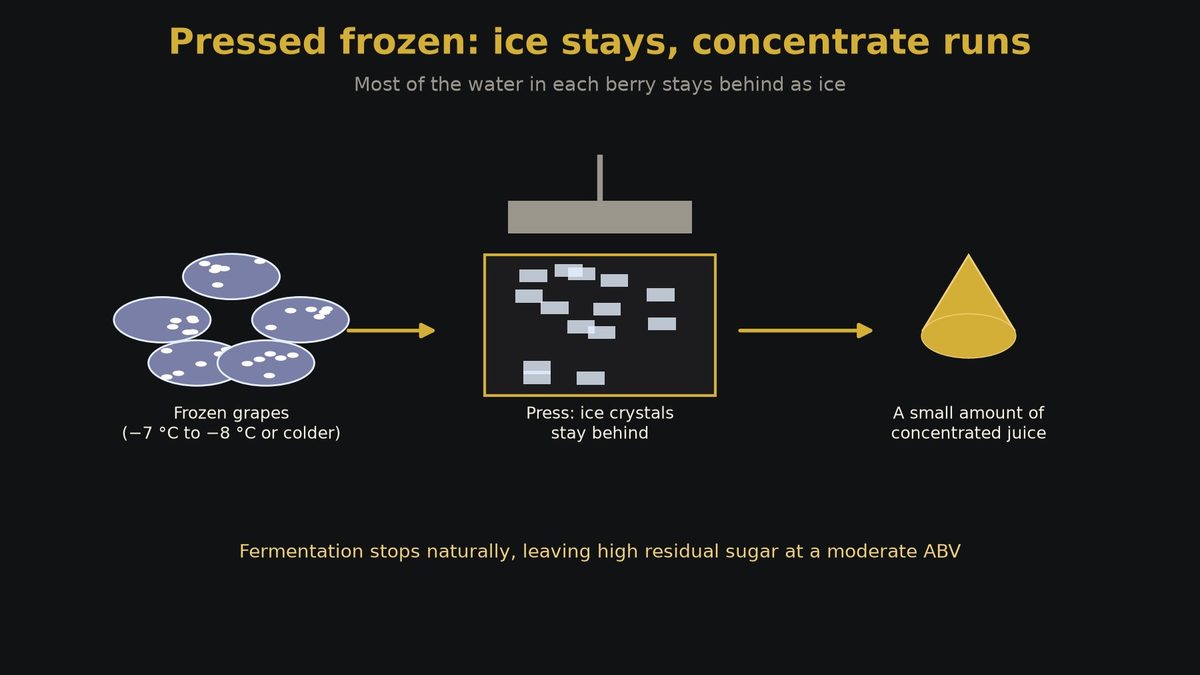
2. Natural freeze. The grapes must freeze on the vine. When the temperature drops far enough, the water inside each berry turns to ice while the sugars, acids and other dissolved solids stay liquid. Labelling rules set the minimum: in one major producing country the grapes must be picked at −8 °C or colder, and under the rules for Eiswein the figure is −7 °C or colder. Producers outside those systems follow their own national rules.
3. Night harvest. Because the coldest hours are usually before dawn, picking often happens at night or very early in the morning, by hand, so the grapes stay frozen.
4. Pressing frozen grapes. The frozen berries are pressed straight away, often outdoors or in an unheated press house. Most of the water stays behind as ice. What runs out is a few drops of thick, concentrated juice per berry.
5. Slow fermentation. The juice is so high in sugar that fermentation is slow and stops naturally well before the sugar is used up. The finished wine keeps a high level of residual sugar and is usually bottled at a moderate strength, often around 8–13% ABV.
Because so little juice comes from each vine, the yield is a small fraction of a normal harvest. That is the main reason ice wine is sold in small bottles.
Icewine vs Eiswein vs "iced" wine
Icewine (one word) and ice wine (two words) are the terms used on many labels. Where the term is regulated, it can only be used for wine from grapes frozen naturally on the vine and picked at or below the legal temperature.
Eiswein is the term for the same method under a different national wine law, with its own rules, including the −7 °C minimum.
Freeze-concentrated or "iced" dessert wines are made by picking grapes at a normal harvest and freezing them, or the juice, in a freezer. The process concentrates sugar in a similar way, but in regulated markets the wine cannot be called icewine or Eiswein. Labels may say "dessert wine", "iced wine" or describe the method instead. If a label is vague, the regulated term is missing for a reason.
Comparison table: how sweet wines concentrate sugar
| Wine type | How the sugar is concentrated | Typical label words | Typical bottle size | Catalogue example |
|---|---|---|---|---|
| Ice wine | Grapes freeze naturally on the vine and are pressed frozen | Icewine, ice wine, Eiswein | 375 ml or 500 ml (sometimes 200 ml) | Scheurebe Icewine 500 ml |
| Noble-rot wine | A beneficial mould dries the berries on the vine | Late harvest, botrytis, selected berries | 375 ml or 750 ml | Style described only |
| Dried-grape (straw) wine | Picked grapes dried on mats or racks for weeks | Straw wine, dried-grape wine | 375 ml or 500 ml | Style described only |
| Late-harvest wine | Grapes left on the vine longer, not frozen | Late harvest | 375 ml or 750 ml | Style described only |
| Freeze-concentrated dessert wine | Grapes or juice frozen artificially after harvest | Dessert wine, iced wine | 375 ml | Style described only |
| Lightly sparkling sweet white | Fermentation stopped early to keep some sugar | Moscato and similar | 750 ml | Voerzio Martini Moscato |
The last row is included only to show a different way a wine can keep sugar. It is not a frozen-grape wine.
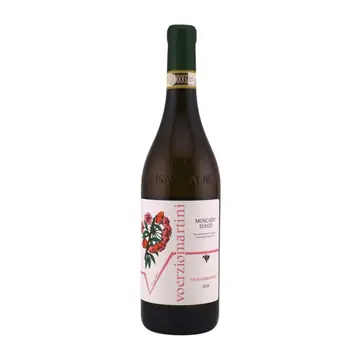
Voerzio-Martini - Vignasergente Moscato
Common ice wine grapes
These grape varieties are the ones most often seen on ice wine labels:
- Vidal (Vidal Blanc). A hybrid grape with thick skins that hangs well on the vine into winter. It is one of the most widely planted ice wine grapes.
- Riesling. A white grape used for ice wine in several cool-climate countries and the traditional grape for Eiswein.
- Cabernet Franc. A red grape used for pink to red ice wines.
- Scheurebe. A white crossing used for sweet wines, including the 500 ml Scheurebe Icewine in our list, which is from the 1998 vintage.
Other varieties are used too. The grape is printed on the label, often with the vintage, which is the year the grapes grew rather than the year they were picked in winter.
Steps: serving ice wine
- Read the label term. Look for "Icewine", "ice wine" or "Eiswein". If it says only "dessert wine", it may be freeze-concentrated.
- Check the bottle size. 375 ml and 500 ml are typical, so one bottle goes further than you might expect at a small pour.
- Chill it. Serve sweet white dessert wines well chilled, around 6–8 °C. Our wine serving temperature chart has the full ranges. Two to three hours in the fridge is usually enough.
- Pour small servings. 60–90 ml per glass is a common serve for dessert wine. A 375 ml bottle gives about four to six pours; a 500 ml bottle about five to eight.
- Reseal and refrigerate leftovers. Use the original cork or a wine stopper and keep the bottle upright in the fridge.
Standard-drink maths
One standard drink is 17.05 ml of pure alcohol. A 75 ml pour of ice wine at 10% ABV contains 7.5 ml of alcohol, about 0.44 standard drink. A 90 ml pour at 12% is 10.8 ml, about 0.63 standard drink. The small pour is the reason a glass of ice wine contains less alcohol than a 150 ml glass of table wine at the same strength, but the sugar content per glass is high.
How long does an opened bottle last?
The high sugar and acidity help an opened bottle keep longer than most table wines. Resealed and refrigerated, many ice wines stay in good condition for several days to a couple of weeks, though they change gradually once air gets in. Our guide to how long opened wine lasts covers each wine category.
Finding ice wine and dessert wine in our catalogue
Ice wine and other sweet whites are listed in the white wine category, within our full wine range. For help with any label term, see how to read a wine label, and for grape-by-grape background, types of white wine.
Frequently asked questions
Why is ice wine sold in small bottles?
Frozen grapes give only a small amount of juice, so each vine yields a fraction of a normal harvest. A 375 ml or 500 ml bottle also suits the small pours used for dessert wine.
What is the difference between icewine and Eiswein?
They describe the same method: grapes frozen naturally on the vine and pressed frozen. Eiswein is the term used under a different national wine law, with its own rules, including a harvest temperature of −7 °C or colder.
Is ice wine fortified?
No. Ice wine is not fortified with spirit. Its sweetness comes from the concentrated juice, and fermentation stops naturally, usually leaving a moderate ABV.
How long does an opened bottle of ice wine last?
Resealed and kept in the fridge, usually several days to a couple of weeks. It changes gradually once opened, so finish it sooner rather than later.
What grapes are used for ice wine?
Vidal, Riesling and Cabernet Franc are the most common, and Scheurebe and other varieties are also used. The grape is named on the label.
What temperature should ice wine be served at?
Well chilled, around 6–8 °C, which is colder than most white table wines.
Related reading
- Wine Serving Temperature Chart
- How Long Opened Wine and Spirits Last
- Types of White Wine
- How to Read a Wine Label
You must be of legal drinking age in your province. ID and adult signature required at delivery.