Riesling Sweetness Labels: Trocken, Kabinett, Spätlese and the Sweetness Scale
Riesling can be bone-dry or very sweet, and the label usually tells you. "Trocken" means dry, while "halbtrocken" and "feinherb" mean off-dry. Kabinett, Spätlese and Auslese describe how ripe the grapes were at harvest, not how sweet the finished wine is. Many bottles also carry a printed sweetness scale, and a lower ABV often signals more residual sugar.
Searches for Riesling have risen through the autumn in Google Trends. In this morning's pull, interest in the grape is well above its late-summer average, a modest seasonal rise that lines up with holiday menus and gift buying. Riesling also has one of the most confusing labels in wine, because a single bottle can carry a dryness word, a ripeness word and a sweetness scale, and they don't all mean the same thing. This guide sorts those terms into two groups: words about sugar in the finished wine and words about grape ripeness at harvest. It then shows how to read a label in five steps. Our types of white wine guide gives Riesling a short overview. This post goes deeper into label terms only, and it describes sugar levels as facts, not as claims about flavour.
Comparison table: Riesling label terms
| Term | What it describes | Regulated? | What it generally means for residual sugar |
|---|---|---|---|
| Trocken | Dryness of the finished wine | Yes | Dry: up to 4 g/L, or up to 9 g/L when the acidity is high enough (see below) |
| Halbtrocken | Dryness of the finished wine | Yes | Off-dry: up to 12 g/L, or up to 18 g/L when the acidity is high enough |
| Feinherb | Dryness of the finished wine | No | Usually off-dry, often in the halbtrocken range, but it varies by producer |
| Lieblich | Dryness of the finished wine | Yes | Medium sweet: above the halbtrocken limit and up to 45 g/L |
| Süß | Dryness of the finished wine | Yes | Sweet: above 45 g/L |
| Kabinett | Ripeness at harvest | Yes | Any sugar level; often light and can be dry or off-dry |
| Spätlese | Ripeness at harvest (late harvest) | Yes | Any sugar level; can be labelled trocken |
| Auslese | Ripeness at harvest (selected bunches) | Yes | Often sweet, but dry versions exist |
| Beerenauslese, Trockenbeerenauslese, Eiswein | Ripeness at harvest, very high | Yes | Sweet dessert wines |
The sugar figures for the dryness terms come from the wine regulations that govern these labels. The "high enough acidity" condition works like this: a wine with up to 9 g/L of sugar can still be labelled dry if its total acidity is no more than 2 g/L lower than its sugar. For off-dry, a wine with up to 18 g/L of sugar qualifies if its acidity is no more than 10 g/L lower than its sugar. The reason is that acidity changes how sugar comes across, so the rules allow a little more sugar in a high-acid wine.
Dryness terms: trocken, halbtrocken, feinherb
These three words describe the finished wine, after fermentation.
- Trocken means dry. It is the most useful single word on the label if you want a dry Riesling.
- Halbtrocken means half-dry, or off-dry. It allows more sugar than trocken but much less than a dessert wine.
- Feinherb is used for wines in a similar off-dry range, but it has no legal definition. Producers choose it partly because many people find "halbtrocken" off-putting. Treat it as "probably off-dry" and check the producer's notes.
If none of these words appears, the wine may still be dry. Many producers only state dryness when the wine is dry, and leave the label silent when it is not. The sweetness scale and the ABV are the next places to look.
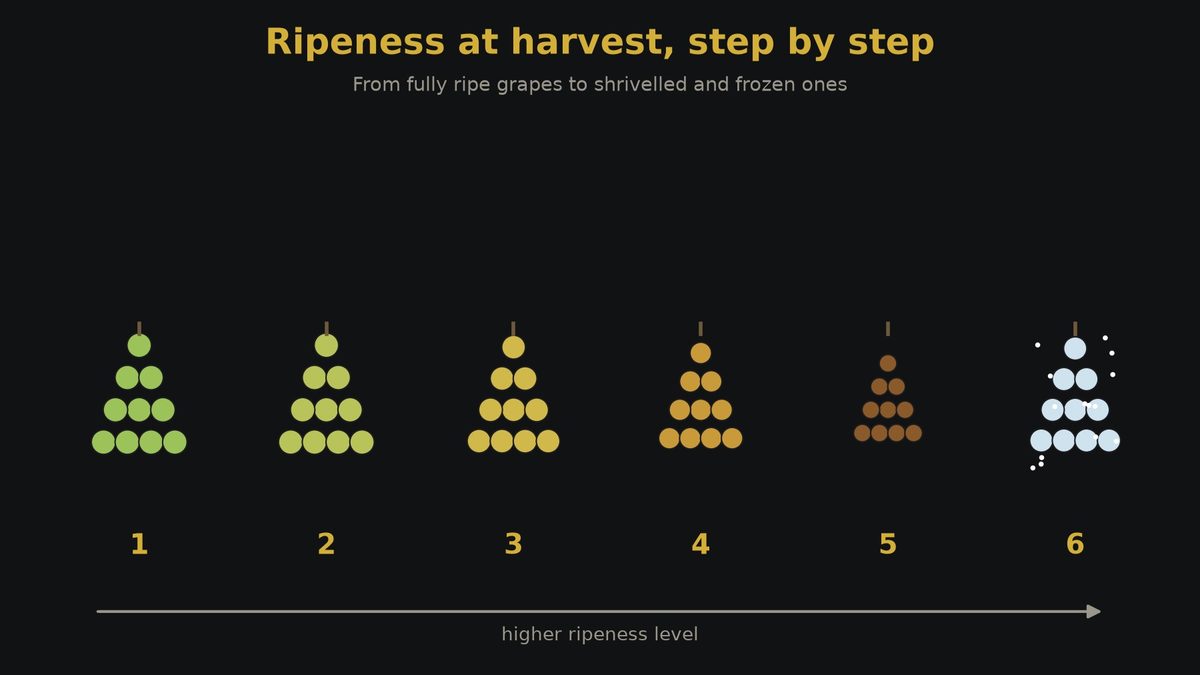
Ripeness levels: Kabinett to Eiswein
The second set of words is the Prädikat system, which classifies wine by the ripeness of the grapes on the day they were picked. Ripeness is measured as the sugar content of the grape juice, called must weight. Higher levels need riper grapes.
- Kabinett is the first level and uses fully ripe grapes from the normal harvest.
- Spätlese means late harvest. The grapes are picked later and are riper.
- Auslese means selected harvest. Very ripe bunches are picked out by hand.
- Beerenauslese means selected berries. Overripe individual grapes are picked, often affected by noble rot, a fungus that shrivels grapes and concentrates their sugar.
- Trockenbeerenauslese means selected dried berries. Only grapes that have shrivelled almost to raisins are used.
- Eiswein is made from grapes that freeze on the vine and are pressed while still frozen. Our ice wine guide explains the process.
The key point is that ripeness at harvest is not the same as sweetness in the bottle. A winemaker can ferment ripe Spätlese grapes until nearly all the sugar becomes alcohol and label the result "Spätlese trocken". Kabinett and Spätlese without a dryness word are often off-dry or sweet, but you can't assume it. The top three levels are almost always sweet, because the grapes contain more sugar than yeast can convert.
The back-label sweetness scale
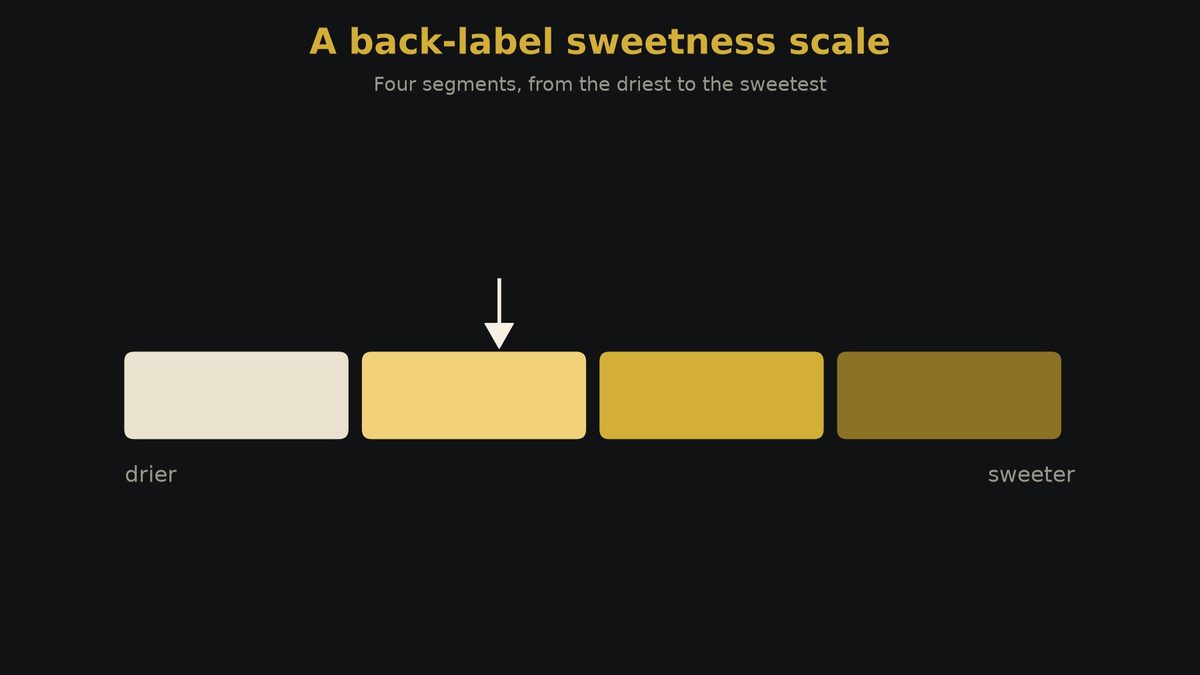
Many Riesling producers now print a simple horizontal scale on the back label, running from dry through medium dry and medium sweet to sweet, with a marker showing where the wine sits. The scale was developed by an industry group of Riesling producers. It is based on the ratio of sugar to acidity, not on sugar alone, so two wines with the same grams of sugar can sit in different places on the scale. It is the easiest guide on the bottle, because it is designed for shoppers rather than for wine law. Not every producer uses it, but where it appears, trust it over a guess from the ripeness word.
The ABV clue
During fermentation, yeast turns sugar into alcohol. If the winemaker stops fermentation early, more sugar remains and the alcohol stays lower. That gives a rough rule for Riesling:
- Around 8 to 10% ABV: often off-dry or sweet.
- Around 11% ABV: could be either.
- 12% ABV or higher: usually dry or close to it.
This is a general guide only. Grape ripeness, climate and winemaking all change it. Use it as a tiebreaker when the label has no dryness word or scale. Our low-alcohol wine and spirits guide lists other wines that are naturally lower in alcohol.
Steps: reading a Riesling label
- Find a dryness word. Look for trocken, halbtrocken, feinherb or, on labels that use plain wording, "dry" or "off-dry". This tells you the most.
- Find a ripeness word. Look for Kabinett, Spätlese, Auslese or a higher level. On its own it describes the harvest, not the finished sugar.
- Check for a sweetness scale on the back label. If there is one, it is the clearest guide.
- Check the ABV. Lower alcohol usually means more residual sugar.
- Check the producer's notes if still unsure. Most producers publish the residual sugar in grams per litre on a technical sheet.
Our guide to how to read a wine label covers the rest of the label.
Riesling labels in plain wording
Many Rieslings are labelled with plain words such as "dry", "off-dry", "semi-dry", "medium-dry", "medium sweet" or "late harvest". These are category words, but the rules behind them differ from one wine law to another, and some of them, such as "semi-dry", have no fixed definition in most places. When a label uses one of these words, read it the same way as a dryness term and confirm it with the scale or the ABV.
Examples in our catalogue include Chateau Ste. Michelle Riesling, Blue Nun Riesling, Cupcake Riesling and Peak Cellars Riesling. Check each bottle's label or producer notes for its dryness and ABV, since the product names don't state them. The white wine category lists all of our Rieslings, and the wine sale page shows what is currently reduced.
Chateau Ste Michelle Riesling
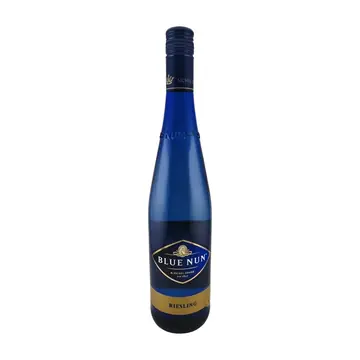
Blue Nun Riesling
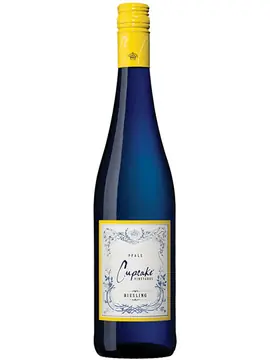
Cupcake Riesling 12/750 ml
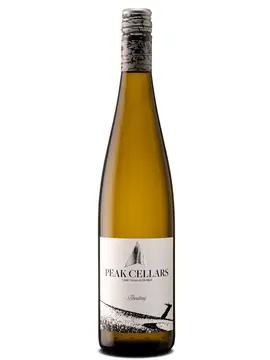
Peak Cellars Riesling
Serving and standard drinks
Riesling is served chilled. Our wine serving temperature chart gives the range for light white wines. One standard drink contains 17.05 ml of pure ethanol. A 150 ml glass of a 9% Riesling holds 13.5 ml of ethanol, about 0.79 standard drinks. The same glass of a 12.5% Riesling holds about 18.8 ml, roughly 1.1 standard drinks. The lower-alcohol bottles are a lighter option per glass, but they still count.
Frequently asked questions
Is Riesling sweet or dry?
Both. Riesling is made in every style from bone-dry to very sweet. Look for a dryness word such as trocken, a back-label sweetness scale or the ABV to tell which style a bottle is.
What does trocken mean on a wine label?
Trocken means dry. It is a regulated term that limits residual sugar to 4 g/L, or up to 9 g/L when the wine's acidity is high enough.
Is Kabinett sweet?
Not necessarily. Kabinett describes the ripeness of the grapes at harvest, not the sugar left in the wine. Many Kabinett wines are off-dry, but dry versions are labelled "Kabinett trocken".
What is the difference between Spätlese and Auslese?
Both are ripeness levels. Spätlese grapes are picked late. Auslese grapes come from selected, very ripe bunches, so Auslese sits one step higher. Neither word alone tells you the final sugar level.
Does a lower ABV mean a sweeter wine?
Often, in Riesling. A lower ABV usually means fermentation stopped earlier and left more sugar. Treat it as a general guide, not a rule.
What does feinherb mean?
Feinherb is an unregulated term for wines that are usually off-dry, in a similar range to halbtrocken. Check the producer's notes for the exact sugar level.
Related reading
You must be of legal drinking age in your province. ID and adult signature required at delivery.