Port vs Sherry vs Vermouth: Fortified Wine Labels Explained
Port, sherry and vermouth are all fortified wines, meaning distilled spirit has been added, but they are distinct labelled categories. Port and sherry are protected names tied to their regions of production, while vermouth is a fortified wine additionally flavoured with botanicals under its own labelling rules.
At a glance
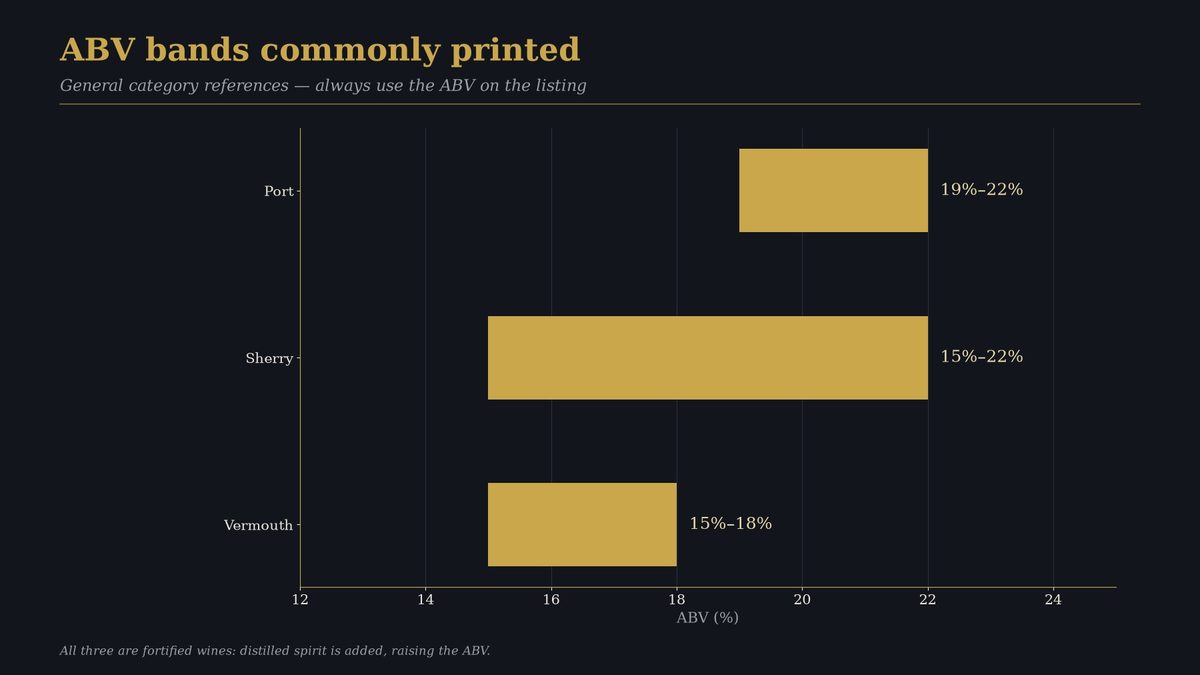
| Category | Defining label fact | Protected origin as labelled | ABV band commonly printed* | Typical bottle size in listings* |
|---|---|---|---|---|
| Port | Fortified wine; styles include ruby, tawny, white and rosé as labelled | Douro Valley, Portugal | Often 19%–22% | Often 750 ml |
| Sherry | Fortified wine; styles include fino, oloroso and cream as labelled | Jerez, Spain | Often 15%–22% | Often 750 ml |
| Vermouth | Fortified wine flavoured with botanicals; sold as dry, bianco or rosso/sweet as labelled | No single protected origin; labelled by producer | Often 15%–18% | Often 750 ml or 1 L |
\*Bands and sizes are general category references. Always use the ABV and size printed on the specific listing.
Product-origin geography above is a labelling fact about where each category is made. Browse the wider list under wine and red wine, with related fortified and spirit categories at brandy and cognac.
What "fortified" means
Fortification is the addition of a distilled spirit to wine. It raises the ABV above the band typical for unfortified still wine and is part of the legal definition for these categories. The exact spirit, timing and ageing rules are set by each category's own regulations and are summarised on the label by the category name itself.
Port
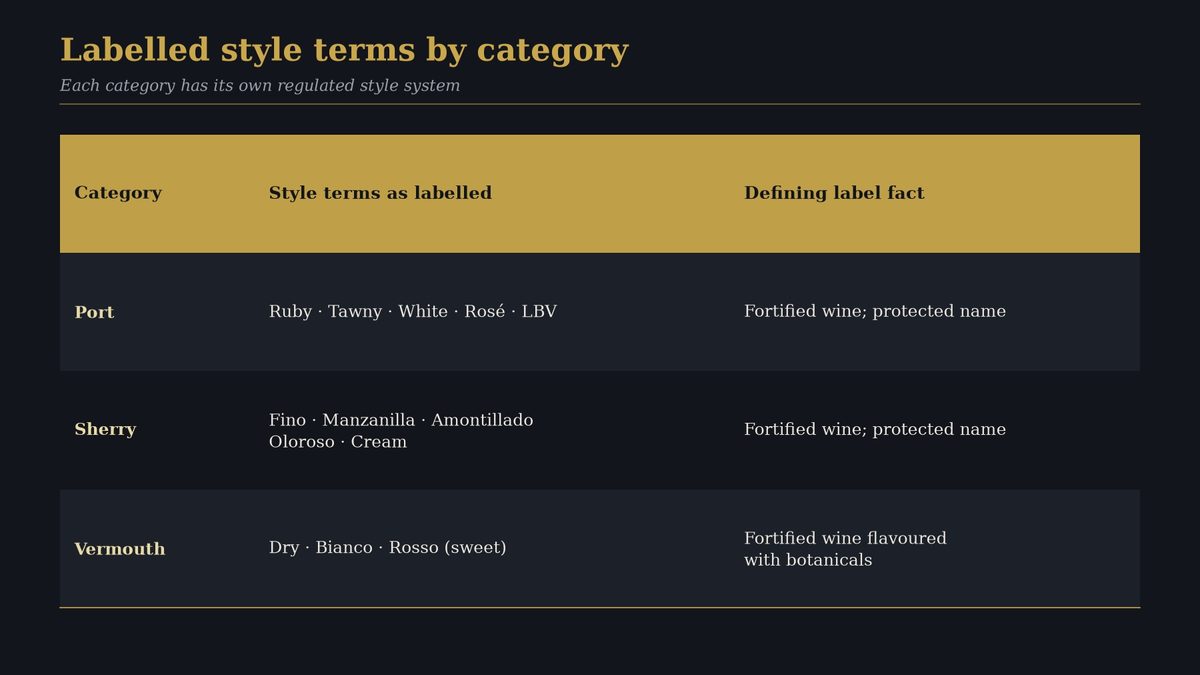
Port is a fortified wine from the Douro Valley in Portugal, protected as a name. Bottles are labelled by style, including ruby, tawny, white and LBV (late bottled vintage) where applicable. A vintage statement, where one appears, is the harvest year declared under the category rules. See also the cognac age-grade comparison in VS vs VSOP vs XO for how a different fortified-adjacent category handles age terms — the systems are not interchangeable.
Sherry
Sherry is a fortified wine from the Jerez region of Spain, also a protected name. Labels carry style terms such as fino, manzanilla, amontillado, oloroso and cream. Those terms are regulated style designations, not general descriptions that can be applied to other wines.
Vermouth
Vermouth is a fortified wine that is also aromatised — flavoured with botanicals — and labelled dry, bianco or rosso (sweet) depending on the product. Unlike port and sherry, the name is not tied to one protected valley or region in the same way; the producer and the labelled style carry the information. Vermouth appears in the Negroni and Manhattan recipes in classic cocktail recipes. A brand page example in the wider catalogue is Hennessy for cognac, which is a spirit, not a fortified wine — a useful label distinction when browsing brandy and cognac.
How to compare listings
Record for each listing: category, labelled style, ABV as printed, bottle size and bottles per case. Then compare using how case pricing works and, where sizes differ, the price-per-litre calculator. Background on still-wine categories is in types of red wine and types of white wine.
Frequently asked questions
Is vermouth a type of sherry?
No. Vermouth is fortified wine flavoured with botanicals; sherry is a protected fortified wine category from Jerez.
Why is fortified wine stronger than still wine?
Distilled spirit is added, which raises the ABV. The exact figure is printed on each label.
Can any fortified wine be called port?
No. Port is a protected name for the defined category from the Douro Valley.
Are style words like tawny or fino interchangeable?
No. Each belongs to its own category's regulated style system.
Related reading
You must be of legal drinking age in your province. ID and adult signature required at delivery.